Showing posts with label review. Show all posts

Sunday, 28 June 2015

"The Psychopath Test: A Journey Through The Madness Industry" by Jon Ronson: Review


“Suddenly, madness was everywhere, and I was determined to learn about the impact it had on the way society evolves. I've always believed society to be a fundamentally rational thing, but what if it isn't? What if it is built on insanity?”  
                                            - Jon Ronson The Psychopath Test

Jon Ronson (The Men Who Stare At Goats) gets into the topic of psychopaths and madness by being pulled into an elaborate scheme of a psychologist who sends out cryptic messages to some 'intelligent' people all over the world. Jon Ronson is then asked to use his investigational skills as a journalist to solve the puzzle. 

By investigating this story his findings lead him, rather unexpectedly, to psychopathy. Finding this topic very interesting, Ronson decides to pursue it further.
Ronson meets a psychologist who is convinced that many people in high official positions are, in fact, psychopaths and that basically the world is run by a lot of people with psychopathic character traits. 
Further, he visits an inmate in an institution for the criminally insane, who has been diagnosed with being a psychopath, but claims not to be one.  His psychopathy was diagnose with a list created by Bob Hare, who is often considered to be the founding father of researching psychopaths. His list is still used to determine whether someone is a psychopath or not. 
In order to learn more about  psychopaths Ronson participates in a seminar  on how to spot them easily. He also does a lot of research on how psychopathy has been treated throughout the years and how it is still treated today. Leading from nude group therapy to LSD-infused group therapy sessions in prisons. 
He also meets with Scientology representatives, who do not believe in mental illness as such, and therefore also not in psychopathy. 

The fact that he approaches the topic from so many different angles makes it very interesting to read and also gives you the impression that the topic is being dealt with on an objective level. At the same time the whole book also has a very personal touch, because you accompany the author on his journey through the madness industry and he shares his, often, very personal thoughts with you. 

The book is very enthralling and I, personally, absolutely love Jon Ronson's style of writing stories, because they grip you immediately and keep you glued to the pages until the very end.

Although while reading the book you might get the feeling that almost everyone around you, including yourself, might suffer from some sort of mental illness or even be a psychopath. At least that's what happened to me, so be warned ;)


Thursday, 21 May 2015

"Holy Cow" by David Duchovny: Review

Holy Cow is the story of Elsie Bovary, a cow, who wrote down her memoirs for the reader (with a little help from co-author David Duchovny).

Elsie enjoys the quiet happy farm life she has lead ever since she was born. It mostly consists of sleeping, eating and spending time with her friends. The only thing she sometimes misses is her mother, who had been taken away years ago. Elsie doesn't know where her mother went but she knows that this was how it always had been, mothers just left after some time and fathers were not really around to begin with. Nevertheless she couldn't be more content with the life she was leading. Up until one day when Elsie and her best friend Mallory realise that they have the sudden urge to meet the bulls who are kept on another part of the farm. So they come up with the plan to escape their stable, by heavily relying on the oldest son's inclination to forget to close the gates due to being constantly distracted by his phone.
When they actually manage to go and see the bulls Elsie is not nearly as interested in them as her friend Mallory is and so she decides she'd rather go down to the farm house and see what is happening there. What she sees when she looks through the window at the TV changes her whole life: the farmers are watching a program about meat production and all of a sudden Elsie's whole world turns upside down.
After she has regained from the shock, Elsie decides to leave the farm as quick as possible. She learns about a country called India, where cows are seen as divine creatures, not eaten and that's her destination.
During her preparations she is joined by Jerry, or rather Shalom, a pig that converted to Judaism and wants to go to Israel, because people don't eat pork there, and Tom, a turkey who cannot fly and who thinks that he'd be save in Turkey, because people there sure wouldn't eat the an animal that is named after their country right? Both of the companions come in very handy during the journey, especially Tom, who can operate the touchscreen of a smartphone with his beak. On their journey the three friends get involved in a lot of adventures, from hijacking an airplane to accidentally reuniting Israelis and Palestinians.

What could easily also be the plot of an animated children's movie turns out to be a delightful story about so much more than just three farm animals making a run for it. David Duchovny's witty writing style and lots and lots of pop cultural references make this book a great choice for some light and funny reading.


Tuesday, 12 May 2015

"Hemingway and Faulkner In Their Time" by Earl Rovit and Arthur Waldhorn: Review

"Writers should work alone. They should see each other only after their work is done, and not too often then."
                                                           - Ernest Hemingway

"A man works for a fairly simple range of things: money, women, glory; all nice to have but glory's best, and the best of glory is from his peers, like the soldier who has the good opinion not of man but of other soldiers, who are themselves brave too."
                                                           - William Faulkner

Rovit and Waldhorn start of their book with these quotes, concerning their peers, by two of the best-known American writers of their generation. And that is what this book is all about.
Hemingway and Faulkner in Their Time is a compilation of letters, interviews and comments from other famous writers, for example Scott Fitzgerald, T.S. Eliot, Gertrude Stein etc, talking about either Hemingway or Faulkner and their works with Rovit and Waldhorn providing additional information and context where it is needed.
And it seems every writer had to say something about at least one of these two men, who, while being well aware of each others works, have never actually met in person. And since some of these things are expressed in letters to friends it is a much more honest opinion on either men than one usually gets from official statements and biographies.

While I absolutely loved this book and the whole time I was reading it it just made me want to go back in time and sit around at Gertrude Stein's flat in Paris with all these brilliant and talented people (a bit like Owen Wilson in Woody Allen's Midnight in Paris), it is by no means an introduction to the works of Hemingway and Faulkner in any way. You will have to have at least a basic knowledge about their work and the other writers of the so-called "Lost Generation" that are mentioned. If you are like me, however, a huge fan of those ladies and gentlemen anyway this is definitely a book you HAVE to read. Enjoy :)

Sunday, 22 March 2015

"Before I Go To Sleep" by S.J. Watson: Review

Imagine waking up in the morning in an unfamiliar house, in a bed you don't recognise, next to a stranger. A stranger who explains to you that he is your husband, that this is in fact your house and that you go through this routine every morning, because you are suffering from anterograde amnesia. That is exactly the situation Christine Lucas, the main character of S.J. Watson's best-selling novel Before I Go To Sleep finds herself in.
Her husband Ben tells her that she was in a car accident about 10 years prior and that ever since then she doesn't remember that occurred after her late twenties. Struggling with the situation, Christine still tries to make the best of it. When Ben leaves her alone to go to work she is contacted by a Dr. Nash, who claims that he has been working with her for the past few weeks to regain her memory without telling her husband. He also hands her a journal she has been keeping, trying to remember. Dr. Nash is also the one to tell her that she was not in fact in a car accident, but that she was attacked at a hotel near the airport and that's what caused the trauma for her amnesia.
Working through her journal Christine starts to remember snippets here and there from her former life. She also remembers a son. Ben tells her that they had one but that he had died as a child. While Christine doesn't really have a reason to mistrust her husband there are more and more things that don't add up with what she remembers and what she is told by former friends and soon she is not sure who she can trust anymore and who even is who they claim to be.
What starts as a interesting story of a woman trying to manage life in her condition and trying to regain her memory soon turns into an extremely suspenseful thriller that keeps you at the edge of your seat.
Like I think I have already said in earlier posts I am usually not really that much into reading thrillers, so that makes it even better when I find one once and again that really blows me away.
There is also a movie version of the book, starring Nicole Kidman, Colin Firth and Mark Strong. While I am not really a Kidman fan I have to say that the movie is also really worth watching and I enjoyed it a lot, even though I already knew how it would end ;)

Monday, 9 March 2015

"Alan Turing: The Enigma" by Andrew Hodges: Review

While formerly probably mostly known to people who have some background knowledge in the fields of mathematics and computer science, the name Alan Turing is now widely known around the globe. All thanks to the Academy Award nominated movie The Imitation Game starring Benedict Cumberbatch (Sherlock) and Keira Knightley (Pirates of the Caribbean). Though neither any of the actors have won an Academy Award in their respective categories, nor the film itself Best Picture, writer Graham Moore received one for Best Adapted Screenplay. I had seen the movie before and Mr. Moore winning this award made me want to read the book even more, to see, how the film had been adapted.

The book by Andrew Hodges has been released in various editions, first in 1983, and revised in the later ones. At first I was a bit vary of reading it, since I am definitely not on the strong side when it comes to maths and considering that Andrew Hodges is a mathematician himself, there was the risk of the book being too theoretical for me. But I can gladly say that, while maths does obviously play an important role in it, the book focuses mainly on the person that was Alan Turing and explains the technical things so well that even I could understand it.
Although usually he is not exactly mentioned as the inventor of the computer as we know it today, Turing did actually design and build the forerunners for our computers. He also invented the so-called Turing Test which is basically supposed to be able to differentiate between a human and a computer and has highly influenced research in terms of artificial intelligence.
One of the best known achievements of Turing, which is also the main focus of the book and the film is, that he helped to decode the German Nazi code known as the Enigma and therefore helped England win the war. This has been kept a secret even after the war had ended and therefore nobody knew what an important service Turing and his colleagues had done to their country.
Unfortunately this did not save him from being arrested for "gross indecency", which was the term for homosexuality and which was illegal at Turing's time. Not wanting to go to prison Turing chose a hormone treatment prescribed by the government which was supposed to "cure" him of his homosexuality. One year into the therapy Alan Turing committed suicide.It is a very sad end of a very complicated man.
Hodges writes about Turing's life and the struggles he had with a lot of understanding. As far as biographies go it is definitely one of the best and the most intimate I have ever read. I especially liked that although admiring Turing, Hodges does tell the whole story and does not present him as a misunderstood hero, but as a brilliant, nevertheless very difficult man.
I know that Biographies are not for everyone, but I definitely recommend this, because it is brilliantly done.

Tuesday, 24 February 2015

"Never Let Me Go" by Kazuo Ishiguro

Never let me go by Kazuo Ishiguro is a noel that paints a dystopic image of the world as we know it. The story is told by the main character Kathy, who narrates her life basically in three different acts. 
In the first part she remembers her childhood at a boarding school called Hailsham for us. Those seem to be her best memories, although it is already hinted early on that this fictional place is not an ordinary boarding school and that the students who have been there all their lives are not ordinary either. 
The students (and the reader) learn soon that they are very special indeed, because they are clones, created to be organ donors when they're grown up. Kathy talks about how every donor is to give as much as possible, but that they usually only get to donate 4 times maximum before they reach their "completion", meaning before they die. 
Already in her memories from Hailsham Kathy tells the reader about her friends Ruth and Tommy, who later on engage in a romantic relationship, although it is always hinted that Kathy is actually the one who has feelings for Tommy and vice versa.

The second part revolves around the characters being around 16 years old and their time after they've left Hailsham and are to live together in huts. In their time at the huts they even try to track down the woman after whom Ruth was created, to find out if there is any likeness in character at all. Disappointingly they find none and begin to wonder whether their creation was actually important at all. 
They also find out later on that Hailsham does not exist any more, because it was only an experiment to try and give the clones a good life and not raise them under inhuman circumstances. Unfortunately the funding for that project has stopped and Kathy, Tommy and Ruth were lucky to have been raised there and have a relatively good childhood.

In the last act we learn that Tommy and Ruth have already become donors and that Kathy is a carer. Carers are clones who take care of others when they have their donations. In those last years Kathy is a carer for both, Tommy and Ruth at some point, before their completion.

I think the book is absolutely brilliant, but it's hard to say that I "enjoyed" reading it, because, while I find the topic it is dealing with highly interesting, it is also very gloomy. The idea of clones as a kind of human spare part boxes is not new, but as opposed to, for example the movie The Island by Michael Bay, which is a typical Hollywood blockbuster with lots of action and motorcycle/car chases, Never let me go approaches the topic very calmly and therefore, makes it seem all the more realistic. Nevertheless, it was a great book and definitely one of my favourites from author Kazuo Ishiguro. I'd also recommend to watch the movie with the same title, which is maybe even a tad darker than the book but otherwise very well adapted to  the screen and with Carey Mulligan, Keira Knightley and Andrew Garfield as the main cast it assembles some of Britain's finest young actors. 

Wednesday, 21 January 2015

"The Unlikely Pilgrimage of Harold Fry" by Rachel Joyce: Review

Harold Fry and his wife Maureen live a very ordinary life in Kingsbridge, Devon.  Recently retired, Harold likes to spend most of his time mowing the lawn or chatting with his widowed neighbour Rex. That is until one day he receives a letter that shall interfere with his daily routine and change his life and his marriage from then on.
The letter he receives is from Queenie Hennessy, a colleague who had worked with Harold in a brewery over 20 years ago. She writes to him to inform him that she has got terminal cancer and that she is currently living in a hospice in Berwick-upon-Tweed.While the news do not seem to affect Maureen very much, they shake Harold to the bone. He hadn't seen Queenie in a long time and they never really got to say goodbye to each other, when she disappeared from one day to another. Not knowing what else to do, he decides to write her a letter, expressing his well wishes. 
He tells his wife that he'll just quickly post the letter and be back. He doesn't even take his mobile with him, because why would you if you only go to the mailbox. But when he's at the mailbox, he can't bring himself to post the letter and so he just walks on to the next one and the next and the next until he is almost out of his town. He decides to get something to eat at a garage and talks to the girl who works there. She tells him that her aunt had cancer as well, and that she thinks that believing one can save a person does actually save them. This is what makes Harold decide to walk to Berwick-upon-Tweed to see Queenie and that he will save her by walking. He calls the hospice and asks the nurse to tell Queenie to stay alive because he is walking to her and he also calls his wife and tries to explain that this is something he has to do. 
From then on he is steadily walking northwards, only wearing his yachting shoes and his everyday clothes. He meets lots and lots of interesting people all over the country who tell him their stories and he tells them his. At some point he becomes so famous all over England that he finds himself with a large group of people who want to walk with him to save Queenie Hennessy. The whole "pilgrimage" of his turns into a media event and eventually the other pilgrims even let him behind because they don't think he will make it in time to see Queenie. 

While Harold is walking he reflects a lot on his life, his marriage and his son David, who is often mentioned by him and his wife, but we never encounter him personally. Gradually the stories and traumata of Harold's past are revealed to the reader by dwelling on his memories with him. It soon becomes very clear that the quiet, boring life and marriage is not at all what it seems. I really liked that the story is told through Harold and Maureen's point of view, because that allows the reader to learn much more about both of the characters and their lives, than if one only gets one side of the story. I am a great fan of the book, because it tells such a moving story in a way you don't read it all the time, but truth be told, it gets a bit repetitive at times, especially towards the end. But I guess that also fits the narrative of the story, because walking through a whole country by foot will be a bit repetitive from time to time. Nevertheless I'd recommend it, because it is a very nice read. 

I am not going to spoil what the reader discovers in the course of the story and if Harold will make it to Berwick-upon-Tweed, because I think that by reading the book you go on some kind of journey yourself and it is great to discover everything piece by piece. 

Sunday, 7 December 2014

"Good Omens - The Nice and Accurate Prophecies of Agnes Nutter, Witch" by Neil Gaiman & Terry Pratchett: Review

Good Omens is the result of a collaboration between two of the greatest writers of our time, Terry Pratchett (Discworld) and Neil Gaiman (Sandman).
To sum up the whole plot of the novel would be rather too extensive but I'm still going to give it a try.
Basically, it's the story of the apocalypse, but not in any way you have read about it before. The demon Crowley and the angel Aziraphale have been living on earth for a few centuries now and they have grown rather fond of it and their lifestyles. Nevertheless they are told by their respective bosses that the Antichrist is about to be born and that he needs to be taken care of, so that he can properly herald Armageddon when he's old enough. Both sides observe the boy growing up, wondering when his destiny will show, since he does not seem threatening in the slightest. Only on his 11th birthday Crowley realizes that he and the satanic nuns might have made a mistake the night the boy was born and that the children seem to have been switched.
From then on it's mainly Crowley running from his bosses and him and Azariphale deciding that they would much rather save the earth they live on. Aside from these two looking for the real Antichrist we also meet Newt Pulsifer, a member of the witchfinder army, who has become aware of some strange things happening in the village of Lower Tadfield, where Adam aka. the Antichrist happens to live. There Newt meets and falls in love with Anathema Device, a descendant of one Agnes Nutter, the very same Agnes Nutter who happened to predict the end of the world.
Crowley, Azariphale and Newt are not the only ones to make their way towards Lower Tadfield, but also the four horseman are on their way to join the Antichrist in bringing about the apocalypse. These four might seem a bit familiar if you are familiar with Pratchett's writing, especially the fact that everything Death says is written in all caps is a feature of Pratchett's Discworld novels.
To see how the grand finale goes down I strongly recommend you pick up the book as soon as possible.

It didn't come as much of a surprise to me that I liked the book as much as I did, because I am a big fan of both Neil Gaiman and Terry Pratchett and even if you haven't read anything by either of the two before, I am pretty sure you will love this book. It is absurd in a way that makes you smile constantly and also very witty, reflecting on society in a way that does not make it feel like it is being shoved in your face.
BBC Radio is also going to release a radio play for Good Omens, featuring some of Britain's finest actors and also featuring the creators Gaiman and Pratchett themselves in a cameo appearance, just in time for Christmas. And as one of the actors who will be in the radio play, Colin Morgan, put it:

"It's a story about the Antichrist. There's nothing more festive than that!"


Friday, 7 November 2014

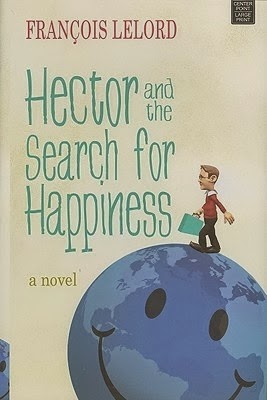
"Hector and the Search for Happiness" by François Lelord: Review

"Happiness is a certain way of seeing things" - François Lelord

Hector is a London psychiatrist who has a seemingly perfect life: a perfect job, a perfect girlfriend, following the routines every day. Until one day in the middle of a session with a patient, he is forced to think about the question whether he is actually happy with his life. Since he cannot truthfully answer that question with a clear YES he decides to go on a trip around the world to find out what makes people happy.
His journey leads him from Shanghai, where he befriends a rich business man, to a buddhist monastery, to Africa where he visits an old friend and helps out in his clinic and to many more stops all over the world. He meets a lot of interesting people and gets even more different answers to the question "What is happiness?"His journey ends in America, where he visits his ex-girlfriend, whom he never quite managed to forget. However, she is happily married and a mother now. She makes him realize that she is not what will him happy and she helps him see what he really wants from his life and what has to do to actually live it this way.


Although Hector and the Search for Happiness deals with a rather philosophical topic it is still a very easy read , because it has a very light air to it. It'll make you laugh, it'll make you cry but most of all it'll make you think about your life and about the question what happiness is for you. At least that's what it did to me. If you happen to be fluent in French you might want to read the original "Le voyage d'Hector ou la recherche du bonheur" since it's usually preferable to read it in the original language. Nevertheless I recommend to read this book no matter in which language. And I also strongly suggest that you watch the recently released movie starring Simon Pegg (Cornetto Trilogy, Star Trek) and Rosamund Pike (Gone Girl). It captures the feeling of the book incredibly well and Simon Pegg did an amazing job playing Hector. 

Tuesday, 28 October 2014

"Life's That Way: A Memoir" by Jim Beaver

Actor Jim Beaver, well known for his roles in Supernatural, Deadwood, Justified etc, published a very personal and honest piece of work in the form of Life's That Way.

Life seems good for Jim and his wife Cecily Adams, both having successful carriers and being the proud parents of little baby girl Maddie. That's when the tragedy strikes the in the life of the young family and Cecily is diagnosed with lung cancer.
To keep friends and family informed about his wife's condition and also as a way of dealing with everything that's happening himself, Jim starts writing a regular e-mail newsletter. Life's That Way is a collection of these very touching e-mails, starting in October 2007, telling everyone about Cecily's condition and ending with an epilogue telling us how life went on for Jim and his daughter after his wife's death.
Reading, how Jim Beaver writes about his wife and life, knowing that those little pieces of extraordinary well written literature are snap-shots of what was actually happening at this point of his life, gives the book an extremely personal touch and I think that it is hardly possible to not be affected by this family's story.
Even though the book is definitely not some kind of self-help book to help you cope with bereavement, reading it did help me personally to deal with a recent loss in my life. Reading Jim Beaver's story and seeing how he copes with everything and stays strong for his daughter is truly amazing and I think that he is a very inspiring person.
If you order a copy on lifesthatway.com you will actually get a copy with a personal message and a signature from Mr. Beaver himself. This little extra combined with how well and with how much emotion the book is written, makes it the most valuable book I own. And considering that Christmas season is almost upon us, I think it'd also make a marvelous Christmas present.

Sunday, 26 October 2014

"Mojo" by Jez Butterworth: Review

This review is going to be a little bit different from the others because Mojo is a 1995 play written by Jez Butterworth.
And since it has been one year since opening night I am going to talk about the written play as well as the production that was staged at the Harold Pinter Theatre in London in the Fall season 2013 starring Ben Whishaw (Skyfall), Colin Morgan (Merlin), Rupert Grint (Harry Potter), Brendan Coyle (Downton Abbey), Daniel Mays (The Adventures of Tintin) and Tom Rhys Harries (Parade's End).

Mojo is set in the 1950s London nightclub scene. Therefore all the characters have a bit of a shady touch to them. The plot evolves around Silver Johnny, a young singer who is currently employed at the club all our protagonists are working. It is hinted right from the beginning that Johnny is considering to work for another man called Sam Ross. Sweets (Grint), who is responsible for the drug supply at the club and Potts (Mays) know about that, but decide not to get involved for now. This scene is incredibly well played by both Grint and Mays, although the lines are generally rather confusing, whether you read them yourself or see them performed. The energy which both actors deliver in their scenes together is amazing and Rupert Grint did an extraordinarily good job on his debut on stage. Daniel Mays was generally absolutely mind-blowing. I did not really know what to expect, since he was the only one of the main characters I hadn't known before, but after having seen the play I have to say that I have never been more impressed with any theatre performance than his.
The next character we get to know is Skinny Luke (Morgan), who works at the club. Colin Morgan's performance definitely showed that he has already had experience on stage and that he is an extremely good actor in general. Especially because his role as Skinny is very different from his role as Merlin, which he is still most famous for until now.
He complains to Sweets and Potts about how the club owner, Ezra's, son Baby (Whishaw) constantly harasses him. This can be also immediately seen in the next seen when Baby makes a appearance. Both Sweets and Potts seem to really care about him but there is never a doubt about the fact that there's something dangerous about him, which is spectacularly delivered by Whishaw who hasn't been called the greatest actor of his generation for nothing.
The four men decide to have a quiet night and play some cards, but the next scene we are shown has nothing quiet about it. Skinny is tied to a jukebox without his trousers, threatened by Baby with a cutlass while both Potts and Sweets are just chaotically shouting around in the background.
That's when Mickey (Coyle) finds them. He's Ezra's business partner and runs the club with him. Mickey tells the four other men that Ezra has been murdered by Sam Ross' men last night and that they'd probably come for them next. Brendan Coyle did a really great job with Mickey as well, but I have to say that both he and Tom Rhys Harries were not as impressive as their fellow cast.
The rest of the play has got a slight Waiting for Godot vibe about it, because all of the men hide in the club, barricade the doors and wait for the inevitable to happen. In the course of the night they drive each other crazy with fear and not knowing what to do. The only one who seems to keep calm in a very eerie kind of way is Baby. Whishaw's performance was absolutely magnificent, especially one of the last scenes where he just stands there, looking at what has happened (not going to spoil the ending here ;-) ), silent tears running down his face, while keeping a stony expression.

Although the plot of the play is very simple, it is still not that easy to summarize (as you might have noticed). Seeing it performed was an amazing experience because the cast was absolutely incredible. As it is always the case with plays, at least in my opinion,  they are never as good if you just read them. That is true for old classics like Shakespeare and also for modern plays like Mojo. I would still recommend to read it and definitely go see it live on stage, if you ever have the opportunity. You sure won't regret it, trust me!

Monday, 21 July 2014

"Retribution" by Jilliane Hoffman: Review

I'm usually not that much of a thriller reader, but when a friend recommended Jilliane Hoffman's Retribution to me I decided to give it a try and I was not disappointed.
Retribution is the first novel in Hoffman's so-called C.J. Townsend series. It focuses on Miami state prosecutor C.J. Townsend who is one of the best in her field and deals with horrible crimes and crazy criminals on a daily basis. C.J. is known for always keeping her cool even in the face of the most cruel cases, that is until she faces the case of a especially brutal serial killer, whose pattern she recognises because she only barely escaped him years ago. She still bears the scars from that encounter and has tried to block out the horrible memories that come flooding back now that she is faced with her tormenter again. Trying to catch the killer who still tortures her in her dreams without having her colleagues find out about her, C.J. is on the verge of losing herself so deep in that case that the line between what is true and what is not starts to get so blurry that she threatens to lose control completely.

Retribution is definitely one of the most exciting thrillers I have read in a long time and a real page turner. Once you've picked this book up you won't be able to put it down until you're finished, trust me.
Even if you're not usually a fan of thrillers, you should definitely give this one a chance, you won't regret it!

Friday, 11 July 2014

"Noughts & Crosses" by Malorie Blackman: Review

A boy is finally allowed to go to a better school, which he could not do so far, due to his skincolour. While he is more than happy about getting a better education, he is still being bullied, because of the way he looks. Sound like an awefully familiar part of history?
But what Malorie Blackman actually does in her Noughts & Crosses series, is reverse the historical roles.
The Noughts & Crosses series are dystopian novels about a society that has not developed the way our world did. In this world, the African people (Crosses) did manage to evolve much faster in various areas and therefore enslaved the white population (Noughts). This first novel is set shortly after slavery was abolished, but it is still looked down upon the Noughts and they generally live very poorly.
This is the world in which the protagonists of the novel, Callum and Sephy, grow up. Sephy is the daughter of a very important and influencal Cross, while Callum is the youngest son of a Nought family, who's mother works for Sephy's family. So they basically grow up together as children and only later in their lives are confronted with their differences. The story evolves around their friendship and the problems their different social backgrounds bring with them.
The novel follows Sephy and Callum throughout their childhood and teenage lives up until their young adult life. The reader sees how they develop together and without each other.
What starts out as a very basic tale about love and friendship develops into a thrilling, critical and heartbreaking page-turner.

When I first started reading the book I expected it to be a very classical young adult love story set in an interesting dystopian world, but I soon realised that there was much more to this book. Blackman tells the story of a whole society through the eyes of two young people who struggle with their place in it.
While the setting is, of course, fictional, the topics and problems Blackman addresses, like racism, terrorism or prejudices, seem way too familiar while reading.
Although I didn't expect it at first the book really gripped me and I had to read it in one go. One reason for that, apart from the fact that it is absolutely well written, is probably that it doesn't happen very often that a book can surprise me and that a story can turn out completely differntly from what I expected.

Wednesday, 9 July 2014

"The Maze Runner" by James Dashner: Review

Waking up in a dark box, remembering nothing but your first name and suddenly being pulled out  by a group of strangers in a place you have never been before - Sounds like a nightmare? Maybe, but that's exactly what is happening to the boy Thomas in the James Dashner's  The Maze Runner. The Maze Runner is the first part of a trilogy (The Scorch Trials, The Death Cure) that evolves around the protagonist Thomas and his friends. Dashner has also written a fourth book The Kill Order which is a prequel to the happenings in the trilogy.


Thomas is thrown into this strange world, where he soon finds new friends in the so-called Gladers. He learns that everyone in the Glade has their assigned duty and so he becomes a runner. That means that he runs through the gigantic maze that surrounds the Glade all day long and tries to find a way out together with his fellow runners. He seems to adjust to his life there until another person comes up in the box and this time it is a girl. So far the Gladers had only consisted of a group of boys and the appearance of the girl, Teresa, sets off a chain of events that threatens everyone in the Glade and everything they have built up until then. A brutal race against time begins for the Gladers and by the end of book 1 they learn that the maze has been the least of their worries...

I first heard about The Maze Runner because of the upcoming movie starring MTV Teen Wolf's Dylan O'Brien. Being also part of the currently very popular Dystopian Young Adult novel genre, I expected it to be similar to The Hunger Games series or the Divergent trilogy. While it is definitely comparable to those series in terms of the genre, I have to say that James Dashner's series adopts a much darker and more grown-up atmosphere in his novels than the others do. Th world of his books is an even gloomier place and everything seems to be more destroyed. The Maze Runner is one of the most thrilling and exciting books I have read in a while and trust me when I tell you that you won't be able to stop before you've read all of them as quickly as possible. Be prepared for a lot of fun and excitement, but also for a lot of suffering and tears. You have been warned!
As for me, I am very excited to see how the movie version turns out, but if they manage to make even remotely as good as the book, there's nothing to worry about ;-)


Tuesday, 8 July 2014

"Set This House in Order: A Romance of Souls " by Matt Ruff: Review

Imagine having breakfast more than 5 times every morning, wearing clothes you can't remember buying or having the taste of cigarettes in your mouth although you don't smoke.
Sounds all rather odd? Exactly! Therefore it has to be the plot of a novel by Matt Ruff. After Fool on the Hill and Sewer, Gas and Electic: The Public Works Trilogy Ruff picks up, yet again, a completely different topic.

Set This House in Order: A Romance of Souls is a book about Andrew, who suffers from a multiple personality disorder. With the help of his therapist Andrew managed to organise the personalities in his head into a house where they all live together and where he can let them out seperately when he needs to. This very organised life he has set up for himself threatens to be disturbed when he meets Mouse, a woman at work, who obviously suffers from the same disorder, but has not come to accept it yet. Her various personalities approach Andrew and ask him to help her come to terms with her condition.

I was rather weary when I first read that the book was to be about a protagonist with multiple personality disorder, because in my opinion it is a very difficult topic to approach and has often been simplified and, to a certain extent, also glorified in movies like for example Fight Club (which is an amazing movie nevertheless).
Ruff, though, manages to approach this topic very elegantly and in a sensitive way. He also goes into the depths of physical and emotional abuse that leads to the protagonists disorders, but this is also approached very delicately and in a empathetic way.

Matt Ruff managed once again to combine the element of weirdness with a lot of emotion and humour, like only he can and Set This House in Order: A Romance of Souls was without a doubt the best read I've had in a long while. Would definitely recommend!